The anatomy of genuine bespoke catering in Singapore
Bespoke catering Singapore platforms often mistake simple substitutions for true culinary customization. Finding food that aligns exactly with an event’s character requires moving past set banquet sheets. True bespoke catering involves engineering a menu around structural dietary needs, precise ingredient origins, and site-specific logistics to turn a private dinner or corporate gathering into a distinct culinary event.
What does genuine bespoke catering mean in Singapore?
To understand genuine custom catering, look at how an executive chef approaches a blank menu sheet. In a market saturated with standard drop-off operations, true personalization means every single flavor profile, sauce base, and course timing is built exclusively for one group of guests. It means the culinary team treats your residential kitchen or corporate boardroom as a functional field kitchen, bringing in the specific equipment, temperature controls, and artisanal products needed to execute fine dining outside a traditional restaurant setting.
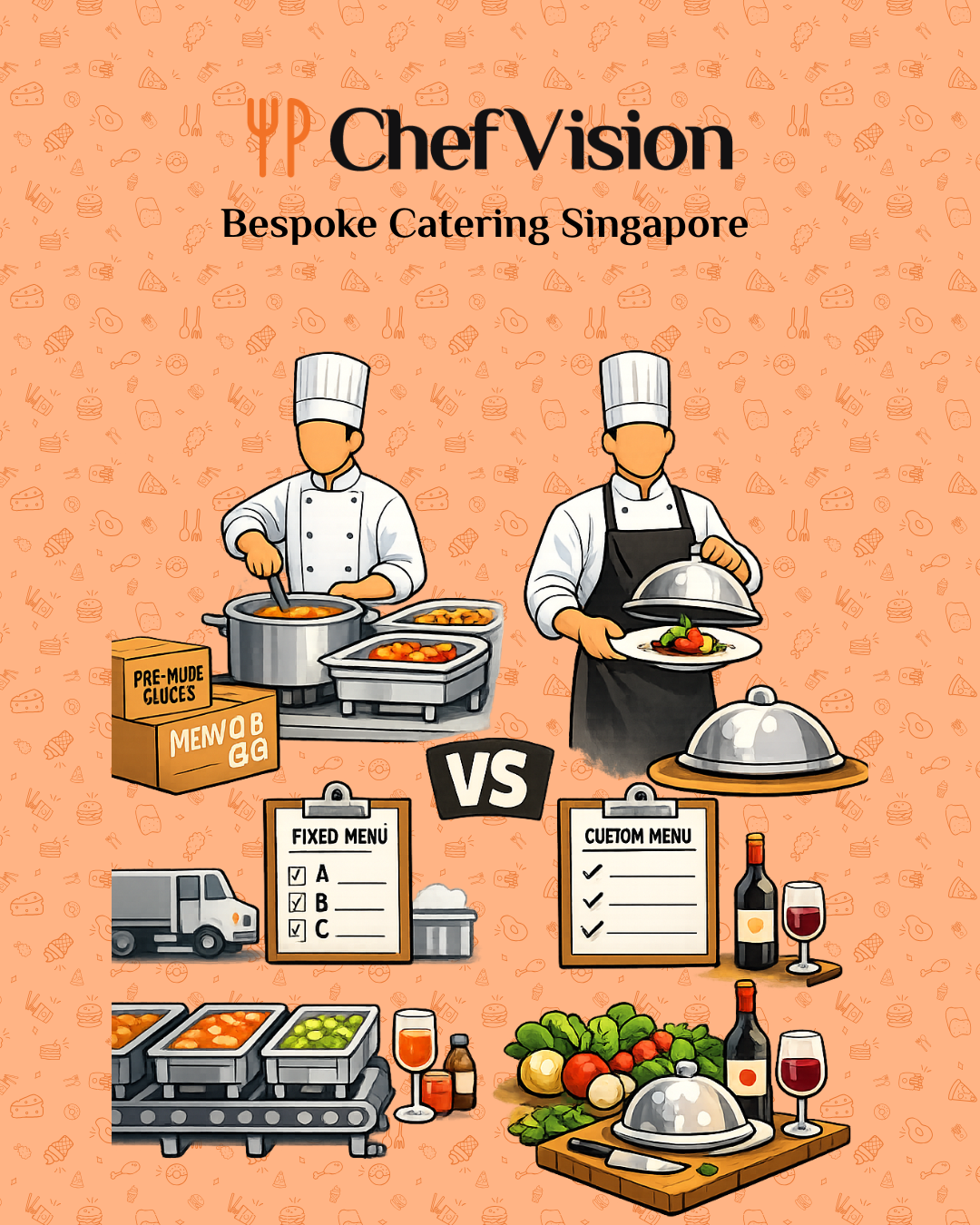
This process moves away from the classic central kitchen production line model. Standard commercial caterers rely on mass preparation by cooking large batches of sauces, starches, and proteins 12 hours in advance, holding them in thermal transport boxes, and reheating them on-site. Genuine bespoke dining relies on immediate, on-site culinary execution.
The process prioritizes real-time assembly, precise searing, and immediate plating. A micro-herb's garnish is clipped right before the dish leaves the pass; a direct sear occurs seconds before a protein meets the plate. This approach preserves structural textures and delicate aromas that inevitably break down during long transport windows.
The misuse of "bespoke" in the local commercial food landscape
The word "bespoke" has become a casual marketing label across the local food and beverage industry. Mass-market operations frequently use the term to describe basic menu adjustments. Swapping out a black pepper beef tray for a stir-fried chicken alternative within a fixed Tier-B buffet package is not a bespoke design. That is simple inventory management.
True culinary customization does not operate within a pre-determined dropdown menu. The commercial illusion crumbles when a client asks for a fundamental change like requesting an entire course free of refined nightshades or asking to match a collection of vintage cellared Barolos with an identically balanced reduction sauce.
Commercial setups cannot handle these requests because their foundational bases, spice pastes, and jus are produced in high-volume central facilities days ahead of time. True bespoke catering means the chef builds those building blocks from scratch, controlling every gram of sea salt, every source of acid, and every fat emulsion to match the event's specific requirements.
Traditional bulk buffets vs. ChefVision private bespoke dining
Operational Parameter | Traditional Bulk Buffets | ChefVision Private Bespoke Dining |
Menu Matrix Formulation | Rigid, pre-set tiers (Menus A, B, C) with fixed item counts. | 100% blank-canvas creation tailored to specific event themes. |
Preparation Location | Industrial central kitchens; bulk batching 8–18 hours prior. | On-site scratch preparation and real-time finish execution. |
Sourcing Protocols | High-volume commercial wholesale distributors. | Farm-to-table, day-of- harvest micro-greens, and direct imports. |
Dietary Flexibility | Decorative labeling (e.g., "Contains Nuts"); no item isolation. | Deep structural reformulation with separate tools and spaces. |
Beverage Integration | Standard box juices, soft drinks, or generic house wines. | Sommelier-backed wine pairings mapped to flavor profiles. |
Staffing Ratios | 1 server to 30–40 guests (primarily replenishment roles). | 1 dedicated service professional to every 6–8 guests. |
Spatial Footprint | Requires extensive setup space for chafing fuel arrays. | Adaptable to home kitchens, yachts, or corporate offices. |
How a master-led private chef consultation works
The creation of a custom menu starts long before the first burner is lit. It begins with a structured dialogue between the host and the culinary architect. This phase eliminates the distance between the person ordering the food and the person executing the dishes. By connecting the client directly with the creator, we ensure the menu reflects the event's goals without getting lost in administrative tiers.
During this session, the chef analyzes the event's specific variables:
The ambient temperature of the dining space.
The exact timing of corporate presentations between courses
The visual style of the room's interior architecture.
The specific sensory memories the host wants to evoke.
For example, a menu designed for an open-air pavilion along the Sentosa waterfront requires a different structural approach than a dinner hosted in a highly air-conditioned corporate boardroom in the Central Business District. Humidity changes how crisp skin behaves, affects how fast reductions set, and alters guest preferences for specific fats and acids.
Gathering the guest blueprint: Dietaries, preferences, and occasion theme
The consultation explicitly avoids general preferences like "Western" or "Asian." Instead, it creates a detailed profile of the guest list's collective palate. The culinary team documents preferred flavor profiles, desired textures, and exact wellness goals.
If a client wants a modern French narrative but has guests who prefer clean Japanese profiles, the chef bridges that gap structurally perhaps using a clear, multi-day clarified dashi double-consommé base accented with cold-pressed local botanicals, rather than relying on heavy butter emulsifications.
This stage also maps out the flow of the event. A seven-course celebration menu requires a completely different kitchen tempo than a quick, high-impact business luncheon meant to fit neatly between executive board presentations. The chef plans the progression of weights, temperatures, and lingering notes so that guests remain engaged without feeling overly full by the fourth course.
Navigating structural dietary reformulations with absolute safety
Managing critical food allergens requires rigorous production control, not just simple menu labeling. In high-volume commercial catering kitchens, cross-contamination is a constant structural hazard. Shared assembly lines, ubiquitous frying oils, and massive ventilation systems make it difficult to guarantee absolute safety for severe food hypersensitivities.
Dietary structural reformulation is the process of re-engineering an entire dish from its foundational elements to completely remove specific allergens or lifestyle constraints while keeping the intended texture, mouthfeel, and flavor balance. It replaces superficial ingredient removal with deep structural adjustments.
When a client indicates a severe allergy such as celiac disease or a serious crustacean allergy, true bespoke catering triggers a strict separation protocol:
Foundational Realignment: The culinary team reformulates the base recipes. If a classic demi-glace requires wheat-based thickening agents, the chef bypasses standard shortcuts and uses long-term collagen reductions or alternative root starches like arrowroot or tapioca to maintain the clean sheen and body of the sauce.
Tool Isolation: Dedicated, color-coded preparation tools, cutting boards, and cooking vessels are set aside exclusively for the sensitive items.
Ingredient Verification: Every raw product undergoes verification right down to the processing facility level, ensuring suppliers do not handle allergen risks on shared machinery.
Airflow and Spatial Segregation: High-risk preparation occurs in isolated spatial blocks to prevent airborne flour particles or aerosolized seafood proteins from settling on allergen-free surfaces.
The logistics of premium on-site culinary execution
Moving fine-dining standards into non-commercial environments requires precise logistical planning. A domestic kitchen or corporate boardroom pantry lacks the heavy-duty power setups, high-volume combi-ovens, and large stainless-steel workstations found in commercial spaces. True bespoke caterers solve these challenges through careful site inspections and specialized mobile equipment configurations.
Operational Execution Metrics
- Advance Site Inspection Window: 72 Hours prior to guest arrival.
- On-Site Chef Setup Window: 120–180 Minutes before the first plate drops.
- On-Site Service Staffing Ratio: 1 Dedicated server for every 6 guests.
The execution team manages spatial layouts directly. If the venue's existing refrigerator space is limited, the culinary team brings in compact, temperature-monitored holding units. This ensures cold starters stay at safe, crisp storage temperatures without crowding the domestic space.
By calculating the electrical draw of mobile induction plates, immersion circulators, and holding cabinets down to the kilowatt, the team prevents tripped breakers during service.
Tableware, clean-up operations, and Chatham House discretion rules
Premium bespoke catering handles the entire lifecycle of an event, including post-event cleanup. The goal is to leave the space exactly as it was found. The team takes care of all logistical details: clearing custom fine-bone chinaware, cleaning glassware, polishing flatware, and managing waste disposal discreetly out of the guests' view.
For high-profile corporate board meetings, private property transactions, and family gatherings, privacy is a core operational requirement. Service professionals are trained to work quietly and maintain total discretion, ensuring sensitive conversations remain strictly confidential within the dining space.
Curated ingredient sourcing and course-by-course menu progression
A custom menu relies heavily on the quality and freshness of its raw ingredients. Instead of relying on bulk commercial distributors who prioritize shelf-life over peak flavor, ChefVision uses an independent network of local and international suppliers.
This hands-on approach allows us to design dynamic menu progressions where every course leads naturally into the next:
The Opener: A delicate starter designed to wake up the palate, featuring day-of harvest micro-greens and bright, cold-pressed citrus accents.
The Mid-Course: A rich, carefully seared line-caught white fish served with a balanced reduction sauce that highlights the natural sweetness of the seafood.
The Main Event: A premium grain-fed wagyu beef cut, cooked precisely to temperature using precision immersion techniques and finished over an open flame on-site.
The Finale: A dessert that manages sweetness thoughtfully, balancing rich local botanicals with crisp texture contrasts to close the meal cleanly.
Frequently asked questions about custom catering in Singapore
What is included in bespoke catering services?
Bespoke catering services cover the complete culinary experience from start to finish. This includes direct menu design with an executive chef, managing ingredient supply chains, coordinating kitchen and service staff, providing premium tableware, and managing complete kitchen cleanup.
How much does a private chef caterer cost in Singapore?
According to regional luxury hospitality tracking, high-end private chef catering in Singapore typically ranges between SGD 180 and SGD 450 per guest, depending on headcount, ingredient selection, and service complexity. Small, intimate gatherings featuring premium imports like wild-caught seafood or imported Wagyu beef sit at the higher end of this range due to sourcing and preparation logistics.
Can you customize a buffet menu for severe dietary restrictions in SG?
While mass-market buffets often just label existing dishes, true bespoke services recreate recipes from scratch. This process involves using separate cooking spaces, dedicated utensils, and allergen-free bases to ensure safety for severe food hypersensitivities.
What is the difference between standard catering and bespoke private chef dining?
Standard catering relies on mass-producing fixed menu tiers ahead of time in central kitchens, then transporting and reheating the food on-site. Bespoke private chef dining builds a custom menu around the host's specific event, prioritizing fresh, on-site scratch preparation and personalized service.
Do bespoke caterers provide tableware and service staff?
Yes, full-service bespoke platforms provide fine-bone china, specialized glassware, premium flatware, and professional service staff trained for high-end hospitality.
Commissioning your tailored culinary event with ChefVision
Planning a successful high-end culinary event requires moving past standard, one-size-fits-all buffet templates. True dining experiences rely on clear collaboration, careful ingredient selection, and precise execution tailored to your specific venue.
Connect with our culinary team at ChefVision to discuss your upcoming event, evaluate your kitchen space, and begin designing a completely custom menu from scratch.
Read more about: Be a Guest at Your Own Dinner Party: The Host’s Guide to Presence