The Ultimate Guide to Baking Classes in Singapore: Master Professional Pastry Skills at Home
Choosing a baking class in Singapore comes down to three factors: hands-on kitchen time, class size, and the specific pastry techniques covered in the curriculum. While generic group workshops offer a casual social activity, specialized training—particularly private baking instruction—accelerates skill acquisition through dedicated chef supervision, tailored feedback, and custom recipe pacing.
What Makes a Great Singapore Baking Class?
- Key Focus: Practical, hands-on technique over simple assembly or mix-and-bake activities.
- Essential Skills: French pastry fundamentals, artisan sourdough fermentation, cake assembly, temperature control, and precision piping.
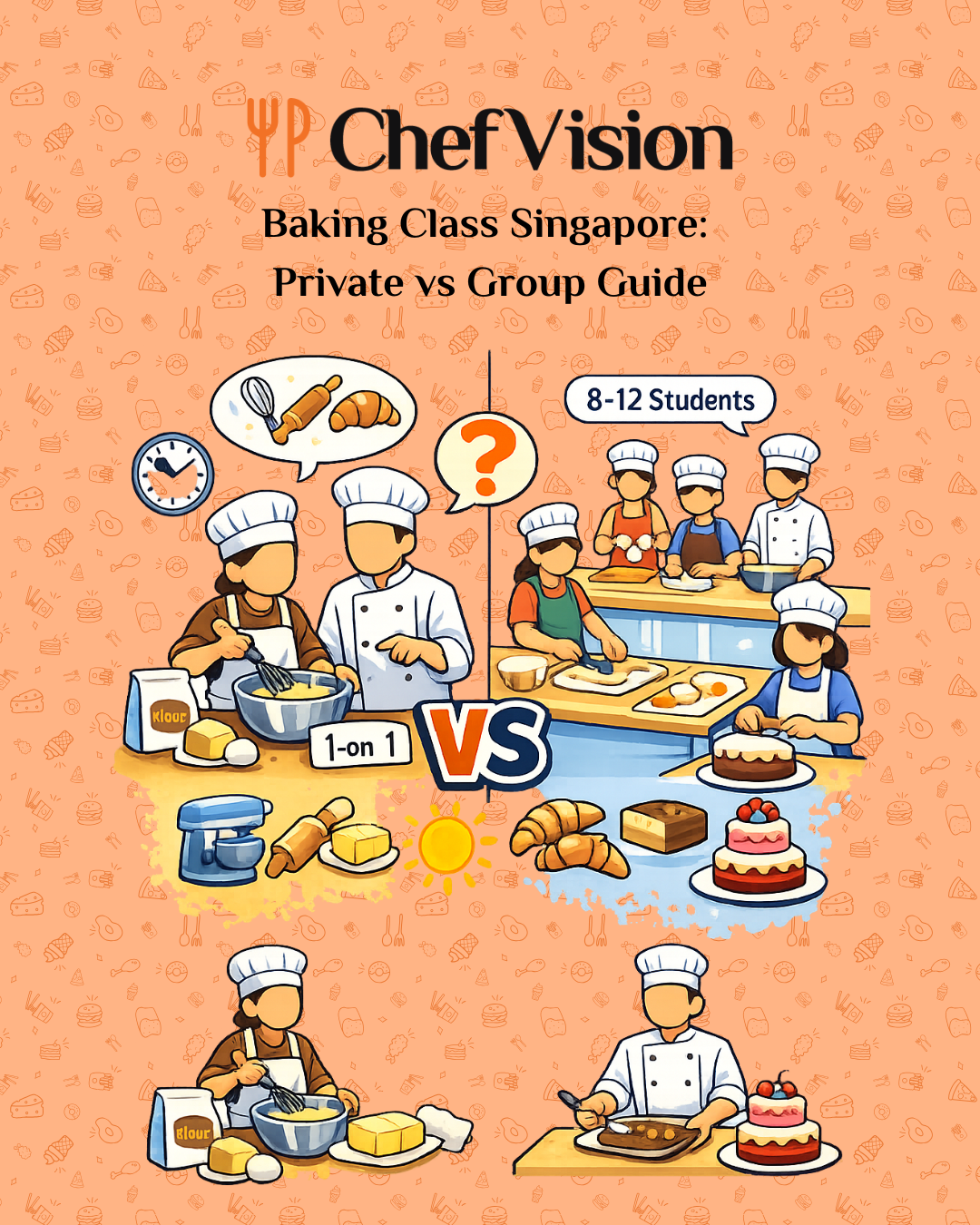
- Format Comparison: Group classes (8–16 students) suit casual hobbyists; private instruction (1-on-1 or small private groups) targets rapid skill mastery and customized dietary needs.
- Primary Recommendation: For learners looking to troubleshoot failed bakes, master complex viennoiserie, or host custom culinary events, private instruction delivers the highest return on time invested.
What to Look for in a Baking Class in Singapore
Selecting the right baking class requires evaluating factors beyond convenience and price. Singapore’s culinary landscape features diverse providers, ranging from community centers and commercial studios to specialized private academies. Evaluating these four structural elements ensures your investment yields practical baking confidence.
1. Hands-On Kitchen Time vs. Demonstration Format
Many commercial baking workshops rely on demo-heavy formats where an instructor prepares the batch while students observe, completing only assembly steps. High-value classes guarantee individual stations where every participant measures, mixes, kneads, and bakes their own creation from scratch.
2. Instructor Qualifications and Industry Experience
The difference between a recipe that works once in a studio and a recipe you can recreate at home lies in the instructor's technical knowledge. Look for educators with professional pastry diplomas (such as Diplôme de Pâtisserie), commercial bakery experience, or extensive background in instructional culinary arts. Experienced chefs teach you how to read batter texture, adjust for Singapore's tropical humidity, and recover from common kitchen mistakes.
3. Equipment and Ingredient Transparency
A quality baking studio provides commercial-grade appliances alongside domestic equivalents. This helps you understand how home convection ovens differ from deck ovens. Furthermore, studios that use professional inputs—European butter (minimum 82% butterfat), unbleached flour, high-percentage couverture chocolate, and natural vanilla—produce superior flavor profiles and teach you how raw ingredients behave under heat.
4. Class Size and Supervision Ratios
Class size directly impacts instructor feedback. In a room of 12 to 16 students, an instructor has only minutes per person to inspect dough consistency or piping technique. A lower ratio (1 to 4 students, or dedicated 1-on-1 private tuition) ensures immediate correction before bad habits form.
Dough Preparation and Gluten Development
Gluten forms the structural backbone of baked goods. Classes covering bread, viennoiserie, or pie crusts focus heavily on controlling gluten formation.
Sourdough & Artisan Bread: Understanding hydration percentages, baker's math, autolyse phases, stretch-and-fold sequences, and bulk fermentation tracking.
Laminated Doughs (Croissants & Puff Pastry): Mastering the mechanical folding process to create distinct layers of butter and dough without melting or tearing.
Shortcrust & Sablé: Learning the "sablage" method to coat flour proteins with fat, preventing excessive gluten development for tender, flaky tart shells.
Temperature Control and Emulsification
Baking relies on exact thermal conditions. Ingredients behave drastically differently depending on ambient and internal temperatures.
Egg Tempering: Gradually raising egg temperatures in custards, curds, and pastry creams to prevent curdling.
Ganache and Buttercream Emulsions: Controlling fat-to-liquid ratios to achieve smooth, stable emulsions that do not separate under room temperature.
Sugar Cooking: Using candy thermometers or visual stages (soft ball, hard ball, caramel) for meringues, pralines, and syrups.
Precision Piping, Decorating, and Finishing
Visual appeal requires fine motor control and spatial awareness. Foundational decorating modules cover:
Proper pastry bag holding angles, pressure control, and nozzle selection.
Smooth crumb coating and final alignment using turntables and bench scrapers.
Working with temper-sensitive mediums like Swiss meringue buttercream, royal icing, and mirror glazes.
The Physics of Tropical Baking: Humidity and Heat in Singapore
Baking in Singapore presents environmental challenges that western recipes often overlook. Ambient room temperatures of 30°C and relative humidity levels exceeding 80% directly alter baking chemistry.
Managing Butter Stability in High Ambient Heat
Butter softens rapidly above 22°C and melts at 32°C. When laminating croissants or making pie crusts in a non-air-conditioned environment, butter leaks out of the dough layer, destroying lamination and yielding greasy, flat bakes. Professional classes in Singapore teach temperature management techniques:
Chilling rolling pins and marble work surfaces before handling pastry dough.
Implementing mandatory refrigeration intervals between fold turns.
Adjusting liquid ratios to offset atmospheric moisture absorption by dry flour.
Flour Hydration and Atmospheric Absorption
Flour absorbs moisture directly from humid Singapore air during storage. A recipe developed in a dry European climate calling for 70% hydration might produce a sticky, unmanageable dough when mixed in Singapore. Professional instruction covers how to adjust water input by 2% to 5% based on daily atmospheric conditions and flour feel.
Tailored Pace and Individualized Attention
In a group setting, instructors must move at the speed of the average learner. Fast learners spend time waiting for others to catch up, while beginners feel rushed through complex steps like chocolate tempering or piping.
ChefVision private sessions operate at your individual pace. If you master sponge mixing quickly, the chef allocates more time to advanced piping or flavor pairing. If your caramel breaks, the chef pauses the session to explain why the sugar crystallized and walks you through fixing it step by step.
Fully Customized Curriculum and Menu Selection
Generic group classes feature fixed monthly schedules. If you want to learn specific techniques—such as gluten-free choux pastry, low-sugar Japanese shortcakes, or vegan macarons—you may wait months for a suitable group class to appear.
ChefVision allows you to design your own curriculum:
Select exact recipes tailored to your palate, skill level, or upcoming occasions.
Modify ingredient lists for dietary restrictions (e.g., keto, nut-free, dairy-free, halal-compliant inputs).
Practice on specialized equipment or focus strictly on mastering your home oven's heat distribution.
Dedicated Troubleshooting and Real-Time Feedback
Baking mastery relies heavily on tactile intuition—knowing how dough feels when properly kneaded or recognizing the exact ribbon stage in egg beating. In a private ChefVision class, the chef observes your posture, grip, mixing speed, and angle in real time.
Home bakes often fail for subtler reasons than incorrect measurements, such as under-developed cake batter from fear of overmixing, or misjudged oven hot spots. Direct 1-on-1 coaching corrects these visual and physical cues instantly.
Flexible Scheduling for Busy Singaporeans
Matching corporate working hours or family schedules with rigid studio calendars can be challenging. ChefVision private classes offer flexible timing across weekdays, evenings, and weekends, accommodating your calendar rather than forcing you to adapt to preset timetables.
Module A: French Pastry & Choux Mechanics
Choux pastry requires precise cook-off times on the stove before egg addition. ChefVision’s private choux module guides you through:
Cooking the panada to the exact stage where moisture evaporates and starches gelatinize.
Adding eggs incrementally until the batter achieves the classic "V-drop" off the spatula.
Piping uniform éclairs and choux craquelin, followed by baking under managed steam profiles to prevent collapsing.
Module B: Artisan Sourdough and Wild Fermentation
Demystify sourdough maintenance in Singapore's tropical climate. This module covers starter feeding schedules, managing sourness levels, scoring techniques for optimal oven spring, and achieving an open, translucent crumb structure.
Module C: Modern Layer Cake Engineering
Learn how to build stable multi-tiered cakes designed to withstand Singapore’s ambient warmth without sliding or bowing:
Baking level, even sponge layers using professional pan preparation techniques.
Formulating light, low-sugar Swiss meringue buttercream that holds clean, sharp edges.
Achieving razor-thin crumb coats and applying smooth final finishes using professional turntables and bench scrapers.
Step-by-Step: What to Expect During Your ChefVision Private Class
To maximize learning outcomes, ChefVision structures every private baking session around a proven five-stage instructional framework.
Stage 1: Pre-Class Consultation & Menu Design
Prior to the session, ChefVision conducts a consultation to understand your baking goals, current skill level, oven specifications, and dietary preferences. Together, you finalize a customized menu designed to target your specific learning objectives.
Stage 2: Workspace Setup & Ingredient Chemistry Brief
Your session begins with a brief overview of the recipe's underlying chemistry. You will examine raw ingredients, review baker's percentages, and establish proper prep layouts (mise en place) to ensure seamless execution.
Stage 3: Guided Execution & Tactile Coaching
You execute every step of the recipe independently, while the chef provides continuous instruction. You will learn to recognize critical transition points by sight, touch, and aroma—such as identifying proper gluten development through the windowpane test or spotting early signs of over-whipped cream.
Stage 4: Oven Management and Real-Time Bake Analysis
Learn how to adapt recipes to your specific oven type (convection, top/bottom heat, or steam-assisted). The chef demonstrates how to position baking trays, manage thermal hot spots, and evaluate doneness using internal temperature probes and visual cues.
Stage 5: Tasting, Packaging, and Post-Class Aftercare
Evaluate your finished creations alongside the chef to analyze texture, crumb structure, and flavor balance. You will receive your complete baked goods, professionally packaged, along with annotated recipe cards and post-class chat support to assist with future home bakes.
Frequently Asked Questions (FAQ)
What is the average cost of a baking class in Singapore?
A generic group baking class in Singapore ranges from S$80 to S$200 per participant for a 2- to 3-hour session, depending on ingredient costs and menu complexity. Dedicated private baking classes typically cost between S$250 and S$600 per session. Private instruction includes fully customized menus, 1-on-1 chef guidance, premium ingredients, and flexible scheduling, delivering greater value for targeted skill development.
Can beginners join ChefVision private baking classes?
Yes. ChefVision private baking classes cater to all experience levels, including absolute beginners. Because the session is held 1-on-1 or in small private groups, the chef adapts the pace, foundational explanations, and hands-on guidance to match your exact comfort level, ensuring you build confidence step by step.
Do I need to bring my own equipment or ingredients?
No. ChefVision provides all required commercial-grade baking equipment, specialty tools, packaging, and high-quality ingredients for classes hosted at our studio. If you opt for a private class conducted in your home kitchen, the chef will provide a list of recommended tools or bring specialized equipment directly to your home.
How do I modify baking recipes for Singapore's humid climate?
Singapore's climate changes how dough and butter behave compared to temperate-climate recipes, so a few adjustments matter most: work with colder ingredients and tools, expect doughs to feel wetter than the recipe describes, and store finished bakes airtight rather than left out. The sections above cover the specific ratios and techniques for each case.
Are ChefVision private baking classes halal-compliant or suitable for dietary restrictions?
ChefVision accommodates diverse dietary requirements. Private sessions allow full customization of ingredients, including halal-certified inputs, pork-free/alcohol-free tools, gluten-free flours, dairy-free alternatives, and low-glycemic sweeteners. Please specify your dietary needs during your pre-class consultation.
Can I book a private baking class as a corporate team-building activity or private celebration?
Yes. ChefVision designs customized private group baking sessions for corporate team building, birthday celebrations, family gatherings, and hen's parties. Private group bookings combine structured hands-on learning with a social, collaborative environment tailored exclusively to your group.
Read more about: Couple Cooking Class